 Payment




The publication is prepared for adults aged 18 or over in England, Scotland and Wales. It uses British English and sterling examples. Northern Ireland and the Republic of Ireland are not silently treated as the same regulatory market.
On this page
- What the guides cover
- What our evidence means
- Independence and limits
- Review and support
- Begin with the thing you are trying to identify
- Follow a payment across its separate records
- Read amounts with their conditions attached
- The table-game collection has a narrow purpose
- The slot collection uses the same evidence discipline
- Great Britain is the scope, not a decorative label
- Documentation review is a distinct kind of work
- Images support the reading experience
- Independence is expressed in the page structure
- Use the service pages for their stated roles
- A practical route through the publication
- What a page can establish without knowing the reader
- Sources and review
What the guides cover
The payment checklist is the starting point for identifying a route before money moves. The wallet section distinguishes stored balances from saved-card checkouts. Individual articles then explain the relevant source account, destination and transaction record.
The game materials cover narrow questions rather than a catalogue of places to gamble. Soft 17, Banker commission and line-versus-ways mechanics each address one rule. They do not offer a system for guaranteeing profit.
What our evidence means
The articles interpret public provider, operator and regulator documentation. An operator example is identified as an example rather than converted into a rule for the whole market. A missing or ambiguous fact is not replaced by a guessed number.
No first-hand deposits, withdrawals, game rounds or customer reviews are claimed. Photographs are commissioned editorial illustrations, not evidence that a displayed payment occurred. Hypothetical arithmetic is identified where it is used.
Independence and limits
This edition has no operator showcase, paid ranking, affiliate redirect or gambling signup button. Links to providers and public bodies support the explanation or lead to help; they do not turn the publication into the account provider.
We cannot inspect a customer's gambling account, trace a transfer or decide a payment dispute. Use the relevant operator, bank or wallet's verified support channel for those tasks. Our contact guidance explains what information belongs with each party.
Review and support
The editorial policy describes source selection, date handling and corrections. A review date records when documentation was checked, not a guarantee that the provider cannot change its service later.
If gambling is becoming hard to control, use the support resources or self-exclusion information. Reading about a payment route never requires opening another account or making a deposit.
Begin with the thing you are trying to identify
Start with the uncertainty in front of you. Perhaps money has left the bank, but you cannot tell whether the next receipt should come from a wallet or a casino. Or perhaps a familiar checkout logo gives no clue which card will be charged. Payment Table GB follows those questions through the accounts and records involved, so the explanation begins where the uncertainty actually lies.
The same approach applies to the game material. Someone looking at ace, six and ten needs to know how the ace is counted before comparing a dealer's action with a soft-total rule. Someone looking at a baccarat return needs to separate the returned stake from the winning profit. These are small reading tasks with practical consequences; they do not require a ranking of gambling operators.
Start with the record or label you actually have. A bank statement belongs with the statement guide, a withdrawal reference belongs with the relevant outgoing-payment explanation, and a rule label belongs with the named game guide. Moving directly to that explanation is often more useful than reading every page in a section. The internal links connect related stages when the first answer reveals a second, distinct uncertainty.
You can finish that task without making a new payment or starting a round. Reading is the activity this publication supports. If the document does not establish an answer, the appropriate next step may be to ask the organisation responsible or leave the transaction untouched. The presence of a guide is not an instruction to use the product it describes.
Follow a payment across its separate records
Consider a hypothetical route involving a bank, a wallet and a gambling account. Adding money to the wallet creates one record; paying a merchant from it creates another. A later withdrawal into that wallet creates a further record, and transferring the wallet balance to a bank adds another stage. Even if some amounts match, the references identify different events.
When a payment is missing, begin with the last confirmed stage. A wallet receipt tells you what the wallet reports; the next step is to check the merchant's corresponding credit. Our guides help you make that comparison from your own records. The publication cannot see those accounts, so it cannot decide which stage completed on your behalf.
A payment method's name is also less specific than it first appears. A card-backed phone checkout is not necessarily a separate stored balance. A bank-authorised checkout is not necessarily the same as typing beneficiary details into a manual transfer. The articles name the product and route before discussing amounts, references or the organisation that can investigate.
A fastest-method label would hide several different waits: the operator reviewing a withdrawal, the payment service releasing it and the recipient recording the credit. Documentation for one stage cannot measure the whole journey. The guides identify the stage a source describes, allowing you to ask about the part that remains unresolved for your own transaction.
Read amounts with their conditions attached
A number becomes useful only when its unit, action and scope are clear. A £1 deposit minimum is not a £1 game stake, a £1 promotion requirement or a £1 withdrawal minimum. Each figure belongs to its own instructions. The comparison material keeps those distinctions attached to the named method instead of promoting the lowest number as an operator-wide promise.
The one-pound comparison illustrates a route-specific documented floor. The ten-pound comparison distinguishes an exact minimum from a route that merely accepts that amount. A reader can therefore see what the evidence proves before deciding whether the category matches the original reading task.
Arithmetic examples have a different job. Dividing a hypothetical balance by a hypothetical stake can explain exposure, while subtracting a commission can explain settlement. Those calculations do not predict how many rounds someone will actually play, how long a balance will last or whether money will be won. The stated assumptions remain part of the example.
If two balances differ, first look for the transaction or rule that explains the difference. We do not assign an unknown fee, derive a deposit minimum from a small balance or treat a promotional figure as withdrawable cash. The guides keep those gaps visible so that a neat-looking comparison does not send you away with an answer the source never supplied.
The table-game collection has a narrow purpose
The table-game guide index brings together three focused explanations. Blackjack soft 17 concerns the value of an ace and the dealer's instruction. Baccarat Banker commission concerns the basis of a deduction and the difference between profit and return. Roulette call bets concern the chip allocation behind a group-selection shortcut. Each page explains its own vocabulary and examples.
These three guides cover a small part of each game. A table may also have its own stakes, payouts, side bets and dealing procedure. Check its help before applying a worked example to the version on screen. Learning a dealer-total rule, for instance, leaves the natural-blackjack payout as a separate fact to find.
There is no connection between understanding a rule and being guaranteed a favourable outcome. A correct total can still lose under the game's settlement. A correctly counted roulette allocation can lose its entire stake. A commission example describes what happens when a specified bet wins; it says nothing about whether the next bet will win.
This distinction allows the collection to serve readers who are checking an old record or simply learning terminology. A new wager is unnecessary for either task. If a past round seems inconsistent with a published rule, the record and round identifier belong with the operator's explanation process. A similar new round cannot prove what happened previously.

The slot collection uses the same evidence discipline
The slot library connects named titles with explanations of their published mechanics. A title, studio description and paytable are different kinds of information. A photograph can illustrate a casino setting, but it cannot establish a game's active return setting or a feature's trigger probability. The written guide must identify the source for any specific mechanical claim.
Features with similar names can behave differently across games. A wild, scatter or expanding symbol requires the exact version's definition; a general description does not establish where it can appear or what it pays. The wild and scatter guide explains that reading distinction, while paylines and ways separates different ways of recognising combinations.
The illustrated rules blocks explain the documented mechanics. They are not verified playable integrations, and a picture cannot confirm a live configuration or a withdrawable balance. Use the written attribution to see what has actually been established, then check the precise game's help for the settings of the version you are looking at.
Readers can move between the slot and payment sections when necessary, but the connection does not merge their claims. A convenient cashier says nothing about a title's probabilities. A correctly described feature says nothing about whether an operator will accept a particular wallet. Keeping those subjects distinct makes both sets of articles easier to check.
Great Britain is the scope, not a decorative label
The intended geographic context is England, Scotland and Wales. Sterling amounts, GB-facing provider documentation and the relevant Gambling Commission material support that scope. A worldwide help page may explain a product feature while leaving local account eligibility unanswered. We do not fill that gap by assuming that every country sees the same product or cashier.
Country labels are particularly important in payment articles. A provider may describe an account in one market while an operator lists a product in another. Both documents can be genuine without jointly proving that a particular GB customer can use the route. The article needs to connect the claim to the appropriate country-specific evidence before presenting acceptance as established.
Northern Ireland and the Republic of Ireland are not included through a casual use of the word UK. Where a source uses a broader label, the relevant article must still explain what is actually supported. The absence of a separate regional guide here is not evidence that the same regulatory or account conditions apply everywhere.
British English and GBP examples make the prose consistent; they do not certify eligibility. An amount shown in pounds can still belong to a different product, a historical table or a different transaction type. Readers should retain the named service, date and action alongside the currency rather than using the pound sign as the whole test of relevance.
Documentation review is a distinct kind of work
This edition is built from public documentation rather than first-hand gambling-account tests. Reading an operator's help table can substantiate what that table publishes. It cannot establish that every eligible account currently displays the same option, that a submitted payment succeeds or that a withdrawal arrives within a particular time. Those would require different evidence.
That distinction applies even when another website claims to have performed a test. A borrowed account story does not become Payment Table GB's own experience. We can use a public source to identify an issue worth checking, but a personal verdict or an unverified screenshot is insufficient support for our claiming a completed transaction or measured service performance.
The review date therefore has a limited meaning. It indicates when the cited material was reviewed for the article. It does not mean that a person monitors every provider continuously, that no subsequent change is possible or that an account-specific restriction cannot apply. The editorial policy describes how the source and the claim should be kept aligned.
A correction can improve an article without turning it into a personal dispute service. A current primary-source link and the precise disputed sentence can establish that a published statement needs narrowing or updating. A full bank statement, identity document or account password is unnecessary for that task and should stay with the appropriate secure provider channel.
Images support the reading experience
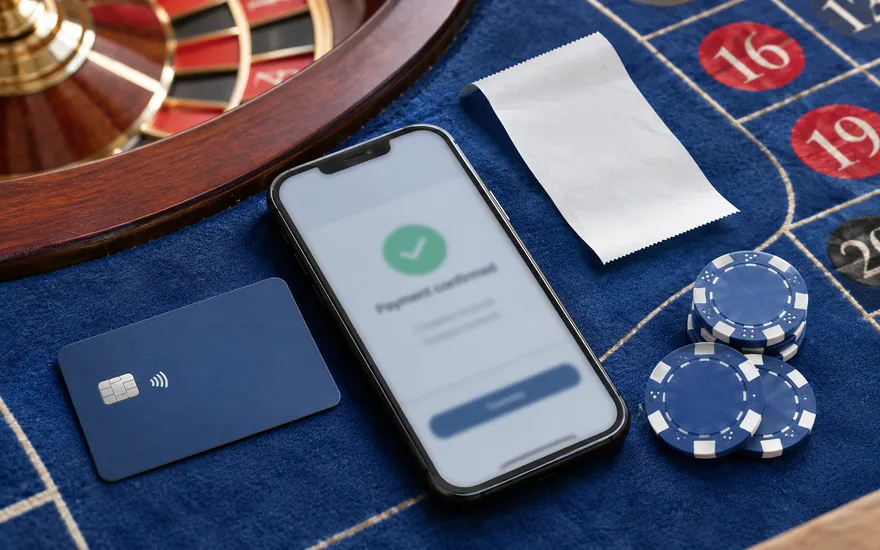
The photographs and artwork provide a casino setting for the explanations. They do not show a reviewer carrying out the payments described. For a checkout amount, look at the cited payment instructions; for a real merchant descriptor, look at the transaction record. Chips, a phone and a staged receipt cannot supply either fact, however realistic the scene appears.
The same limit applies to game imagery. An ace and six can illustrate a soft-total explanation, but the actual dealer procedure comes from the named game's rules. Decorative roulette chips cannot prove the allocation selected in an interface. Where a number matters, the prose or a labelled calculation supplies it explicitly rather than asking the reader to infer it from artwork.
This separation is useful when a page is viewed on a small screen or an image fails to load. The central explanation should still identify the payment route, rule or calculation. Captions clarify the illustration's purpose, while surrounding text carries the claim that can be checked against documentation. Readers should not have to decode a picture to discover an unstated minimum or settlement condition.
An image also does not establish that the publication has visited a venue, interviewed a dealer or received endorsement from a payment provider. None of those experiences is claimed here. The evidence boundary remains the written attribution even when a scene looks realistic or resembles an ordinary casino environment.
Independence is expressed in the page structure
There are no paid operator league tables, affiliate redirects or signup offers in this preparation edition. The purpose of an external link is to identify evidence or reach an appropriate public service. An internal reading link connects two explanations. Neither kind of link should be interpreted as the publication opening an account or acting on a reader's behalf.
This matters most where a comparison includes a named operator. A route-specific official example does not become a recommendation for that operator's games, support or wider service. The article explains the fact the source supports and leaves unrelated judgements unmade. A short substantiated comparison is preferable to a long list padded with supposed acceptance or invented ratings.
The publication's name is also distinct from the payment products and games it explains. Payment Table GB does not provide a wallet, a bank account, a gambling balance or a live table. The explanatory layout cannot override a provider's own terms, restore access to an excluded account or authorise a payment that an account control prevents.
Once the original question is answered, there may be nothing else to do here. Understanding a route does not require testing it with money. Where an answer needs access to a private account, the guide points to the responsible organisation; it cannot complete the task by inviting you to gamble again or open a different account.
Use the service pages for their stated roles
The privacy page describes this local static preparation and the limits of what has been established for a future public deployment. It does not invent an operating company, a retention schedule or a monitored contact address. A service page is useful only when its statements match the actual configuration and arrangements rather than an imagined finished organisation.
The contact guidance helps separate an editorial correction from a transaction trace or operator complaint. There is no direct editorial inbox in this edition. The page explains the evidence appropriate to each task so that someone does not send account secrets to a publication that cannot inspect the account or resolve the transaction.
The support page and self-exclusion page lead to independent official information. They do not diagnose a reader, register an exclusion or promise a particular treatment outcome. Their role is to make the appropriate route clear without requiring any further gambling, payment or participation in this publication.
A bank entry, an editorial correction and a need for gambling support each call for a different response. The service pages explain who can help with which task and what information belongs with them. That makes it easier to act on the answer without sending financial records to a publication that cannot investigate them or mistaking a correction request for a support service.
A practical route through the publication
For a payment-reading task, begin with the payment-method collection or the wallet guide and choose the route that matches the real record. Then read the outgoing stage separately if the issue concerns returning money. The aim is to identify the parties and references, not to create a new account or test an uncertain payment with a small transfer.
For a game-reading task, begin with the table-game index or slot collection and choose the precise term or title. Keep the hypothetical example separate from the rules displayed in the actual version. If a past outcome is disputed, stop at the existing record and request an explanation using its identifier rather than trying to recreate it through further play.
For an uncertainty about this publication, use the editorial, contact and privacy pages together. They explain what is sourced, which arrangements have not been established and what the local edition actually does. A missing public-launch detail remains a missing detail; it should not be silently supplied by a conventional-looking footer or a stock policy paragraph.
Finally, if the reading itself is increasing pressure to gamble, the relevant next page may be the support information rather than another guide. No amount, feature or payment method needs to be tried in order to understand the boundary. A useful editorial outcome can be a clearer record, a better-directed inquiry or the decision to stop.
What a page can establish without knowing the reader
A public guide can define a soft total, explain a payment reference or reproduce a stated calculation without identifying the person reading it. That is an advantage of keeping the task narrow. The article does not need to know a household income, an account balance or a card number to explain what a public instruction means.
It also means that a guide cannot decide whether a transaction suits an individual account. Eligibility, available funds and account controls remain with the relevant services and the reader's actual circumstances. The publication should not ask for more personal information merely to create the impression that a general explanation has become a tailored decision.
When a page directs someone to a provider, the purpose is to obtain an authoritative answer about that provider's own record or instructions. When it directs someone to independent support, the purpose is different again. The useful outcome is a clear division of responsibility, with private details supplied only through the actual service's appropriate process. An explanatory site can make that division understandable without becoming another recipient of financial records.
Sources and review
Reviewed 10 November 2026. GB account context is informed by the Gambling Commission's public guidance. This page describes the scope and practices of this publication.