 Payment




Start with the label or record you have, then follow the matching guide. A hand total, a bet return and a payment reference need different explanations. These pages cover the selected terms in detail rather than every rule of a table game. Check the exact game's help for anything the guide leaves outside its scope, including the conditions attached to a particular version.
On this page
- Choose the guide by the uncertainty
- Blackjack: identify the usable ace value
- Baccarat: separate the profit from the returned stake
- Roulette: count the allocation behind the group name
- Definitions, procedures and settlements do different work
- Keep stake, profit and total return in separate columns
- One action can contain several units of exposure
- The exact version remains the controlling context
- Payment documentation answers a separate set of checks
- A completed round needs its own record
- Work through a reading example without opening a game
- Distinguish a source claim from an illustration
- Support and exclusion remain independent routes
- Keep the next step proportionate to the task
- This index is a reading destination
- Sources and review
Choose the guide by the uncertainty
If your uncertainty concerns an ace and a dealer's action, start with soft 17 blackjack. If it concerns a deduction or a displayed return on a winning Banker bet, start with baccarat Banker commission. If a roulette group button appears to commit more than one chip, start with roulette call-bet allocations.
The guides define the term and work through conditional examples, with sources for the relevant rule. You can use them to read a past record or compare public instructions without opening an account. If the example resolves the uncertainty, that can be the end of the task; recreating the round would add no evidence about the old one.
Choose by the fact that needs explaining. For an ace total, read the blackjack guide; for a deduction from a winning Banker bet, read the commission guide. Follow a related link only when it addresses a further issue. The current game's own rules still supply version-specific details, so an unrelated article cannot fill a gap simply because it appears in the same collection.
The shortest useful route may therefore be one article and its source. A clearer definition, a corrected calculation or an identified unknown can complete the reading task. More pages and more gambling are unnecessary once the original uncertainty has been resolved.
Blackjack: identify the usable ace value
The soft-17 guide begins with ace and six, which can total 17 while retaining the lower total of seven. The ace is usable as 11 without the hand exceeding 21. That makes the total soft. Ten and seven have the same numerical total but do not have that adjustable ace, so they are hard 17.
The distinction can change when a card is added. Ace, six and ten total 17 only when the ace counts as one. The hand still contains an ace, but it is hard. The guide uses that contrast to show why the whole hand matters more than an ace icon or a remembered starting total.
H17 and S17 then identify the dealer's procedure on the soft total. They do not tell a player which action to choose or establish what a natural blackjack pays. Those other rules need their own instructions. A correct definition is the starting point for reading the procedure, rather than a complete blackjack strategy.
Use this article when a record or table label leaves you unsure which total was present. Retain the full cards, the participant and the exact version. A screenshot showing one ace is insufficient to decide either the total or whether the dealer followed the applicable procedure.
Baccarat: separate the profit from the returned stake
The Banker-commission guide explains a conventional 5% winning-profit deduction using clearly labelled amounts. In its hypothetical £20 winning-stake example, the commission is £1, profit is £19 and total return is £39 including the original £20. Those three numbers describe different parts of the same conditional calculation.
A return is therefore not automatically profit. Confusing the two can make a correct settlement appear too large or too small. The guide also explains why calculating the percentage on the stake-plus-profit amount uses the wrong basis for that stated example. The percentage needs its object as well as its numerical value.
No-commission variants require their exceptional rules. A title does not establish that every winning Banker bet pays even money. The destination article identifies a published named-version example and keeps it separate from the conventional calculation. It also distinguishes ties and separately placed side bets, which cannot be settled from the main-bet label alone.
Use this guide when a game history's win field, credited amount or deduction needs interpretation. First identify the version and bet. Then determine whether the amount shown is profit, total return or a resulting balance. The publication cannot infer the whole round from one visible number.
Roulette: count the allocation behind the group name
The roulette call-bet guide explains the common single-zero allocations for Voisins du Zéro, Tiers du Cylindre and Orphelins. A shortcut can place several component bets with one action. The selected chip value is therefore not necessarily the total exposed, and the number of covered pockets is not necessarily the number of chip units.
The guide distinguishes five-unit Orphelins en cheval from eight-unit en plein coverage, and explains the overlap at 17 in the split-based allocation. It also separates a neighbours setting from a named sector. Similar vocabulary does not establish identical cost or coverage.
Conditional calculations show why the whole allocation belongs in a net-result comparison. One split can win while the other components lose. A displayed component payout does not establish the profit across the complete group until the full cost is considered. Decorative chips in an article image are not the allocation record.
Use this destination when the group label or total stake is the uncertainty. Keep the denomination, accepted components, winning number and round identifier together for a historical inquiry. A fresh spin with the same shortcut would create another event rather than verify the original one.
Definitions, procedures and settlements do different work
These three subjects sit at different stages of reading a game. Soft 17 first classifies a hand; H17 or S17 then supplies a dealer instruction. A roulette call bet defines a group allocation before the result. Baccarat commission describes settlement of a qualifying winning bet. Each label needs to be applied at the stage it actually addresses.
Mixing stages can lead to an apparently precise but irrelevant answer. Knowing that ace and six is soft does not tell you a withdrawal minimum. Knowing that Tiers uses six units does not tell you the winning number. Knowing a commission percentage does not establish whether the Banker hand won or which bets the customer placed.
First identify what the rule acts on, then read its instruction and calculate the stated consequence. For a hand, retain all the cards. For a group bet, retain the accepted components. For settlement, retain the bet, result and payout rule. If an input is missing, identify it before doing the arithmetic; a precise calculation cannot repair an assumed starting point.
This order also makes provider inquiries clearer. Ask about the uncertain stage rather than describing every issue as a payout problem. The operator can explain its round record, while a payment provider explains its separate transaction. The contact guidance describes how to route those different tasks.
Keep stake, profit and total return in separate columns
The same money vocabulary appears across the collection, but its meaning should remain consistent. Stake is the amount exposed on the relevant bet or allocation. Profit is the net gain for the scope being discussed. Total return includes returned winning stake where the stated rule returns it. A resulting account balance may also contain money from earlier events.
For a hypothetical £20 baccarat bet returning £39, profit is £19 if that is the only bet being counted. For a hypothetical roulette group costing £6 and returning £18, profit across the group is £12. Both examples subtract the full relevant exposure, even though their game rules and winning components differ.
If another bet loses in the same round, it must be included before describing the net result of the whole round. Conversely, an unrelated earlier balance should not be described as part of the latest return. The scope of the calculation matters as much as the arithmetic.
Each worked example states the assumptions needed to repeat its arithmetic. Compare those assumptions with the exact version, accepted bets and display convention in a real record before using its labels. An illustrative stake may not be offered at every table. The calculation explains the specified result, without forecasting the next round or establishing the conditions of a different installation.
One action can contain several units of exposure
Roulette makes the difference between an interface action and a financial amount especially visible. One group button can place nine, six or five units in the common examples. A repeat or multiplication control can then affect the entire selection. The compact appearance of a control does not reduce the amount it commits.
The same reading habit is useful beyond roulette. A slot interface may distinguish a line figure from a total round stake, while a side-bet area can add a separate amount to a main table bet. The paylines and ways explanation addresses another kind of component-versus-total distinction. It does not establish a particular table's stake limits.
Always identify the total associated with the confirmed action. A chip denomination, a highlighted number count and a resulting balance are different fields. If the amount is unclear before confirmation, the useful next step is to read the help or ask for clarification rather than authorise a small test.
This matters for comparing a payment amount with a game amount. A low deposit minimum does not guarantee that the selected multi-unit allocation fits the resulting balance. The cashier and game require separate checks; neither should be used as a reason to increase an amount already chosen.
The exact version remains the controlling context
A table-game family can contain several rule sets. A blackjack title can differ in dealer instruction and natural payout. Baccarat can replace commission with exceptional settlement. Roulette can present alternative allocations or neighbours controls. A familiar name or visual layout is insufficient to establish identical rules across versions.
Read the title and the help for the version actually open. Then compare the specific instruction with the definition in the relevant guide. If the public help and visible label appear inconsistent, retain the wording and ask the operator to clarify before taking another action. Do not assume the interpretation that produces the return you expected.
The linked primary documents are examples of published rules. They are not endorsements of the operators or a promise that every eligible GB account has access to the same game. A provider's product description can explain a mechanism while leaving a particular installation's configuration or availability to another source.
The editorial policy explains these evidence boundaries. We do not borrow another reviewer's personal test, claim a transaction occurred because a photograph looks realistic or fill a missing rule with a guess. A clearly identified unknown is preferable to a confident answer for the wrong version.

Payment documentation answers a separate set of checks
The payment-method collection and wallet collection identify the accounts, routes and references involved in moving money. They concern eligibility, source and destination, amounts and records. The table-game guides concern cards, allocations and settlement. Understanding one subject does not establish the answer to the other.
Use the rule record for a game question and the payment record for a transfer question. A saved-card checkout cannot alter a roulette payout; a baccarat calculation cannot establish a withdrawal destination; a blackjack instruction cannot identify a bank descriptor. If more than one issue exists, keep its evidence with the relevant enquiry so that each organisation can explain its own part.
The £1 comparison and £10 comparison use documented route-specific GBP amounts. Those figures are distinct from game stakes, promotion requirements and withdrawal floors. If the cashier amount and the intended game do not fit the same chosen budget, the comparison can end without another payment.
Similarly, a crypto-related route may include an earlier conversion before an ordinary GBP payment. That funding history does not alter a table's rules. The route must be understood on its own evidence rather than treated as a way to change a settlement or bypass an existing account protection.
A completed round needs its own record
For a historical uncertainty, preserve the exact game and version, round identifier and the relevant cards or bets. Then record the rule being applied and the amount or action in dispute. This is more useful than relying on a memory that the result looked unusual or that a large win label appeared briefly.
In blackjack, the sequence and full dealer hand help establish whether the total was soft at the disputed moment. In baccarat, the placed positions, stakes and final result help separate profit from return. In roulette, the accepted allocation and denomination determine the group cost before the winning components are examined.
The operator's verified support route can explain its actual history fields and applicable rule. Payment Table GB cannot retrieve a private record, decide liability or release a balance. The contact page helps prepare the inquiry while keeping credentials and unrelated financial documents out of an editorial message.
Another round is unnecessary for that inquiry. It creates another result and another amount exposed without verifying the old event. If continuing the task increases pressure to recover money, leave the game material and use independent support. The original identifier remains evidence without further play.
Work through a reading example without opening a game
Imagine three separate hypothetical notes. The first says ace, six and ten, dealer stood. The relevant first task is to count the hand: its valid 17 uses the ace as one, making it hard. A discussion of hitting soft 17 cannot be applied merely because an ace appears in the note.
The second note says £20 winning Banker stake, 5% commission, £39 returned. The relevant task is to distinguish returned stake from profit. Subtracting the £20 stake leaves £19 profit, consistent with the stated conditional calculation. The note does not establish a bank-transfer fee or show that the next bet will win.
The third note says six £1 Tiers splits, one winning split returns £18. The relevant group cost is £6, so the net group result under that stated example is £12 profit. Counting only the winning component's £17 profit would ignore the five losing units in the same allocation.
Work through each note on its own. Together they illustrate how a clear question leads to the right count or calculation, without describing a combined session or suggesting an order of play. All the inputs are already on the page. An account, deposit or playable integration would add nothing needed to understand the specified arithmetic and its stated scope.
Distinguish a source claim from an illustration
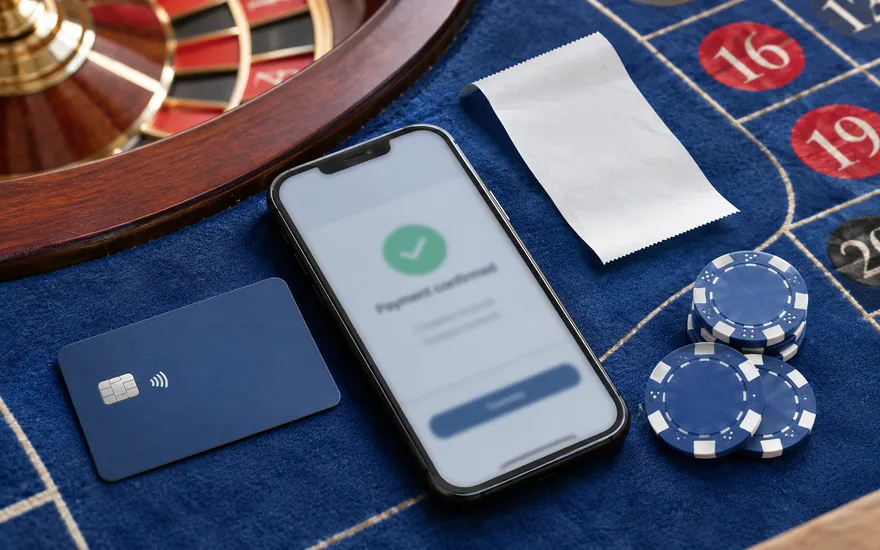
The photographs give the articles a casino setting. For an allocation or a worked return, use the numbers stated in the text and the cited rules. A realistic receipt or chip stack cannot verify a reviewer deposit, a played round or an account-specific credit. Reading the explicit calculation also keeps the explanation usable when the image is unavailable or hard to see.
The same applies when a guide includes attributed provider material. An image can identify a product or illustrate a feature without proving that every operator offers it or uses the same configuration. The relevant claim still needs the written source and its scope. Visual similarity cannot fill a missing rule.
The about page explains the publication's documentation-based approach. No first-hand deposits, withdrawals or table rounds are claimed. A review date records a source check rather than continuous monitoring or a guarantee that a provider's help cannot change. Read the source alongside the condition attached to the article's claim.
For an editorial correction, the useful evidence is the exact disputed sentence and a current primary-source document. A private gambling balance or identity document is unnecessary for explaining that a public rule has changed. The unavailable direct contact arrangement in this preparation edition is made explicit on the contact page.
Support and exclusion remain independent routes
Reading rules does not remove the possibility of losing the full amount staked. A clear calculation cannot make a future result certain or make an additional payment appropriate. If the subject is increasing an urge to gamble, you can leave the guide and go directly to the gambling-support page.
That page links to independent organisations whose current information describes their own services. Payment Table GB is not a treatment, emergency or account-support service. You do not need to decide on a diagnostic label, recover a loss or finish a promotion before using the official support routes.
The self-exclusion guide distinguishes operator processes, online multi-operator coverage and land-based settings, alongside separate bank and device controls. A restriction is not a reason to search the payment collection for another route. The relevant task is to understand and maintain the protection through the responsible organisation's process.
Existing money can still raise an administrative question after a decision to stop. That inquiry can concern an old reference or return of a balance without another wager. Keeping the support need and the administrative record distinct helps identify the right organisation for each, while avoiding the idea that gambling must continue to resolve either.
Keep the next step proportionate to the task
For a definition, use the relevant guide and check the contrasting examples. For a version-specific instruction, read the current game's own help. For an existing discrepancy, preserve the old record and ask the operator through its verified process. For a payment trace, identify the last confirmed financial stage and the provider responsible for it.
Use only the steps the question requires. To understand why ace, six and ten is hard 17, count that hand and stop. To check a roulette group cost, multiply its accepted units by the denomination. Once those inputs resolve the uncertainty, there is no need to expand the enquiry into unrelated rules, a longer tour of the site or another gambling action.
The collection's GB context means British English and sterling examples for adults in England, Scotland and Wales. It does not silently extend every regulatory or service statement to another market. Nor does a pound sign establish that a worldwide product page describes a GB customer's account eligibility.
Use the payment checklist when the next actual uncertainty concerns a route before money moves, or the editorial policy when it concerns how a claim is supported. The outcome can be a clearer record, a better-directed inquiry or the decision to stop. No additional transaction is required to complete the reading task.
This index is a reading destination
The links here open explanatory pages. They do not load a live table, connect a payment account or submit a stake. A photograph and a conditional calculation can explain a concept without establishing that a playable provider integration is present. Read any version-specific help at the actual service when the task concerns that version.
A topic's place in the navigation tells you where to find its explanation. It does not confirm that a named operator offers every related game to a particular GB account. Check availability with that service when it matters. Here, the links take you to the rule, example and source needed for the informational question, which can be answered without creating another gambling event.
Sources and review
Prepared 11 November 2026. This publication-specific index connects three existing rule guides; its examples are hypothetical and do not report played rounds or transaction tests. Consult the linked guide for the complete explanation and source context.
- Blackjack soft-17 guide and sources
- Baccarat Banker-commission guide and sources
- Roulette call-bet guide and sources
- How Payment Table GB uses evidence
- PokerStars: soft 17 and the named Classic Blackjack dealer procedure
- Paddy Power: published baccarat settlement and tie example
- Grosvenor: published single-zero roulette group allocations
These primary pages were accessible for the 11 November 2026 review. The roulette guide also retains an older PokerStars rules link whose direct opening redirected to the provider homepage during this check; that redirect is not used as evidence for this index's allocation summary.