 Payment



On this page
- What is the difference between direct crypto and converted pounds?
- What do GB primary sources actually say?
- Why is a coin name not enough to identify a transfer?
- Which costs belong in a crypto payment comparison?
- How should the amount be read when value changes?
- Does a blockchain confirmation mean a casino balance is credited?
- Which ordinary payment routes can be compared instead?
- What information would justify adding an operator here?
- Draw the route before comparing its labels
- Give each quantity its own unit
- A quote and a completed record have different roles
- Use a transaction identifier for its actual system
- A destination must come from the intended recipient
- Do not read a reversal promise into the word recovery
- Read regulatory evidence with its date and role
- Make the comparison answer the original payment task
- Reconcile a conversion before a later payment
- Questions about crypto casino payment methods
- Sources and review
What is the difference between direct crypto and converted pounds?
A direct crypto route requires the receiving service to identify the asset and supported network. The payment record describes a transfer of that asset. A conversion route instead exchanges an asset for money before a later card, bank or wallet payment. The casino can therefore receive GBP without ever receiving the asset that originally funded the customer's payment account.
Check what reaches the merchant. A card issued by a crypto-related service can still produce an ordinary card transaction, so it is not proof that the casino receives Bitcoin or a stablecoin. Likewise, an exchange's ability to transfer money to a bank tells you about that transfer only. The bank and merchant must each support the later payment under their own conditions.
| Route | What reaches the next recipient | Evidence needed before calling it supported |
|---|---|---|
| Direct asset transfer | The specified crypto asset on a specified network | The operator's explicit asset and network instructions |
| Conversion followed by bank payment | A fiat-currency payment | Conversion record and the separate bank/cashier instructions |
| Card funded through another service | A card transaction | Issuer conditions and actual merchant acceptance |
The comparison is about understanding a payment, not finding a way around an unavailable cashier option. If an operator does not list a direct asset route, a blockchain address found elsewhere is not a substitute for official instructions. If a bank or account control prevents funding, changing the origin of the money does not remove that restriction.
What do GB primary sources actually say?
The Gambling Commission's crypto-assets guidance identifies additional risks, including changes in fiat value and customer-identification challenges, and requires notification of changes to customer-payment arrangements. It does not establish a consumer shortlist of approved crypto casinos. A payment-method comparison needs operator-specific evidence in addition to a general description of the technology or regulatory process.
A parliamentary answer dated 14 May 2025 said that no licensed GB gambling operators then allowed cryptocurrency payments. It also described obligations that would apply if an operator wished to accept them. That statement is historical evidence with an explicit date; it cannot honestly be presented as a live census of every operator on 10 November 2026.
The dated evidence leaves a current question unanswered: this review has not substantiated a direct-acceptance example for a GB customer. That is the limit of the finding. It is too broad to declare every possible arrangement impossible, and equally unsupported to supply a named accepting casino. An offshore recommendation or borrowed international list would not resolve the missing local evidence.
Why is a coin name not enough to identify a transfer?
Some assets can be sent through more than one network. The sender and recipient must support the same relevant route; matching the visible coin name alone does not establish compatibility. Coinbase's own transfer help explicitly separates asset selection from network selection. That is a useful general distinction, without implying that a Coinbase account is accepted by any particular casino.
The address and any additional reference required by the receiving service also belong to the specific transfer instructions. Do not infer them from an older receipt or an unrelated website. A displayed destination should be associated with the intended account and supported asset route. Unclear instructions are a reason to stop, not to send a small experimental payment to an uncertain destination.
Provider recovery tools are not a universal undo button. Coinbase documents limited recovery for certain unsupported transfers, while warning that unsupported deposits may be lost. Another service can have different capabilities. It would be misleading to promise that an incorrect network or address can always be repaired, or to describe blockchain transfers as automatically refundable like an ordinary merchant cancellation.
Which costs belong in a crypto payment comparison?
Separate the purchase or conversion cost, any sending-service charge, the network-related cost and any receiving or later fiat-payment charge. These can be different deductions by different parties. Coinbase's fee disclosure, for example, describes a sending charge based on its estimate of prevailing network fees. That published example is not a universal fee schedule for every wallet or exchange.
A headline saying free deposits can concern only the receiving operator's own charge. It does not prove that acquiring an asset, converting it or transferring it is free. Compare the amount leaving the original account with the amount and currency credited at the end of the route. Identify any difference using the actual transaction records rather than assigning it to an assumed casino fee.
| Cost question | Record that can answer it | Common confusion |
|---|---|---|
| What was exchanged? | Conversion quote and completed trade record | Treating an asset price as the GBP credit |
| What was deducted for sending? | Sending-service transaction breakdown | Calling every deduction a casino fee |
| What was received? | Recipient's asset or fiat credit record | Assuming the submitted amount equals the credited amount |
| What could be withdrawn later? | Separate outgoing instructions | Extending deposit conditions to a different return route |
For a real cost comparison, obtain the supported route, amount, relevant quote and account terms. A fixed charge can affect a small transfer differently from a percentage fee, and a network's general reputation cannot tell you the total deduction. Without those figures, a cheapest-coin ranking would substitute an assumption for the transaction breakdown the reader actually needs.
How should the amount be read when value changes?
A crypto quantity and its estimated GBP value are different figures. The quantity can remain unchanged while the estimated value moves. If conversion occurs, the rate and timing determine the resulting fiat amount. A screenshot of a pound estimate at the start therefore does not prove the amount another service will later credit or make available for withdrawal.
An illustrative record might contain an asset quantity, a conversion into GBP and a separate bank transfer. Each entry answers a different question. Keep their dates, amounts and references together when reconciling the route. Do not collapse them into one supposed casino transaction, especially if the casino's own record only shows an ordinary card or bank payment in pounds.
This distinction also matters for a minimum. A fixed GBP cashier floor cannot be satisfied merely by showing that an asset's estimated value was above that floor earlier. The actual payment accepted through the supported route is what matters. Our £1 comparison and £10 comparison use published GBP minima rather than fluctuating asset estimates.
Does a blockchain confirmation mean a casino balance is credited?
A blockchain record and a merchant account record describe different systems. A confirmed transfer can establish an on-chain event while leaving a separate recipient-credit question unanswered. Coinbase's troubleshooting guide tells customers to inspect transaction status, confirmations and the expected network. None of those checks, by itself, proves that a particular gambling account has received a usable balance.
Follow the transfer through the sending service, the network record and the recipient's credit, where those stages exist. A payout from a casino also has its own approval and release work. Knowing that the network processes quickly leaves those other stages unanswered. To investigate a delay, find the last confirmed event and ask the organisation responsible for the next one.
Do not repeat a transfer merely because the final screen has not changed. Identify the original reference, the actual status and the receiving instructions first. A second transfer creates a second payment to reconcile. This guide does not provide a route for sending funds to an unconfirmed casino destination or bypassing a provider's account checks.
Which ordinary payment routes can be compared instead?
Where a casino publishes a conventional GBP method, evaluate that documented product on its own terms. A saved-card checkout, separate wallet balance and manual bank transfer have different records and outgoing arrangements. Their availability is operator-specific; this page does not claim that every method in our navigation works at every casino or for every account.
The Apple Pay guide explains the underlying-card distinction. The wallet comparison separates a wallet receipt from a later bank transfer, and the manual bank-transfer guide focuses on beneficiary details and references. These are reading routes, not recommendations to replace a blocked payment or open extra accounts to fund gambling.
Compare only methods that fit the controls already in place. A restricted account, bank gambling block or personal spending limit is not a technical obstacle that a conversion service should solve. If the reason for considering crypto is an inability to stop or control payments, use the independent support resources instead of searching for an alternative funding path.
What information would justify adding an operator here?
A usable acceptance claim needs the operator's current GB-facing instructions, the exact asset and network, the credited currency and the separate outgoing route. A generic coin logo or international review is insufficient. Account availability, charges and minimums must come from their own relevant sources; they cannot be inherited from another operator using similar software.
Any future comparison would also need a dated distinction between published documentation and a transaction test. We have performed no deposits, withdrawals or wallet transfers for this guide. The editorial policy explains that boundary. Until sufficient operator-specific evidence exists, the page remains an explanation of payment types rather than a fabricated list of direct-accepting GB casinos.
Draw the route before comparing its labels
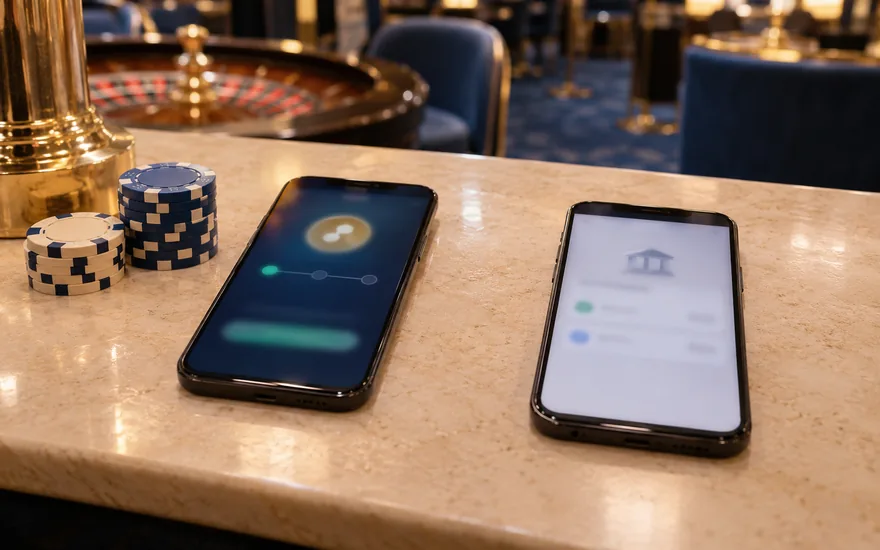
A simple route description can prevent several different services being called one crypto deposit. Identify what leaves the first account, whether a conversion occurs, what reaches the next account and what the casino would actually receive. A digital asset sold for GBP before an ordinary bank payment creates a different sequence from a direct asset transfer to a receiving address.
In a hypothetical three-stage sequence, an asset is converted into £50, £50 reaches a bank account and a separate £10 card payment is then made. The casino payment record concerns the £10 card transaction. It does not establish direct acceptance of the asset or show that the entire £50 reached the gambling account.
Use the map to interpret existing records. It is not a sequence you need to create to understand the distinction. Each provider's conditions and account controls still apply to its stage. If an instruction is unclear, stop and clarify it; if a restriction prompted the search for another method, conversion is not a reason to bypass it or obscure where the money began.
Give each quantity its own unit
A quantity of an asset, an estimated pound value and a completed GBP credit answer different questions. Writing the numbers without their units makes them easy to confuse. Keep the asset name with its quantity and the currency with each fiat amount. If two estimates were captured at different times, retain those times as part of the comparison.
Suppose a hypothetical record shows one unit of an invented asset with an estimated value of £10, while the later completed conversion credits £9.50. The example does not establish a 50p fee. The difference might involve the quote, conversion timing or disclosed costs; the actual records must explain it. The calculation identifies a difference without assigning an invented cause.
A later payment can differ again because it is a new action. A GBP bank balance containing £9.50 does not prove that £9.50 was deposited at a casino. Read the separate payment receipt and accepted method. A current asset valuation is likewise not evidence of a completed past cash deposit or a particular withdrawable amount.
A quote and a completed record have different roles
Keep the quote and the completed transaction record with their original status labels. The quote shows what the provider proposed under its terms; the later record shows what it reports executing. Comparing them can help explain a changed amount. Describing the saved preview as a completed transfer, however, would erase the point in the sequence that still needs to be checked.
For a cost comparison, keep the source deduction and destination credit together with the relevant breakdown. A percentage fee and a fixed charge can have different effects on a small amount. A hypothetical £1 deduction from £10 is ten per cent, while the same £1 deduction from £100 is one per cent. That arithmetic does not identify any provider's real charge.
The existing Coinbase fee disclosure is an example of why a current transaction breakdown matters. Its information is qualified by product, region and transaction context. This guide does not copy an unrelated figure into a GB casino comparison or claim that a single published charge represents every stage of an asset-to-GBP route.
Use a transaction identifier for its actual system
Label each reference with the system that issued it: blockchain, exchange conversion or operator withdrawal request. The organisation may be able to locate its own event from that number without seeing the rest of the route. Including the system name in an enquiry helps avoid asking a bank or operator to inspect an exchange's private ledger from an unrelated identifier.
For an existing unclear transfer, identify the last confirmed stage and ask the responsible service about its own status. If the sending record shows an asset transfer but the intended recipient shows no credit, the supported asset and network instructions matter alongside the reference. A public explorer result alone cannot establish how a private recipient account has recognised the event.
Do not publish personal account material alongside a public identifier to make an editorial point. The contact guidance explains how to prepare a provider inquiry through a verified channel. This publication cannot inspect an exchange account, authenticate an address as belonging to a particular person or decide whether a recipient should have credited a payment.
A destination must come from the intended recipient
An address copied from a forum, an unsolicited message or a previous unrelated payment is insufficient evidence of the destination for a current supported route. The receiving service's official instructions must identify what it accepts and where. A coin logo or a familiar-looking account page cannot replace that connection between the intended recipient and the actual transfer instructions.
The existing Coinbase transfer guidance distinguishes supported assets and networks. The relevant point here is that a matching asset name alone does not settle route compatibility. This publication has not confirmed a direct GB casino destination, so it supplies no address or network selection for sending money to an operator.
An unclear destination is a reason to stop before authorisation. A small experimental transfer can still be lost and does not establish the legitimacy of the recipient or the wider outgoing arrangement. Nor does a recipient's successful receipt establish that a gambling service is appropriately available to the person sending. Technical transfer and account eligibility remain separate questions.
Do not read a reversal promise into the word recovery
Read a provider's recovery description for the transfers it actually covers. A limited tool for an incorrect asset or network is not a general undo facility for every payment error. The linked information about unsupported deposits explains the service's own limits; another provider may handle the same type of error differently. A general reassurance would leave those important conditions out of the enquiry.
For an existing error, use the sending or receiving service's verified support process and provide the relevant existing record. Do not give a recovery phrase, password or one-time code to an unexpected person offering help. Those credentials are unnecessary for correcting a public guide and should not be distributed as proof that a transaction took place.
Payment Table GB does not trace assets, recover funds or appoint recovery agents. It cannot promise that a payment is reversible because another payment type has a dispute process. An accurate inquiry describes the actual route and asks the responsible provider about its own capabilities, without authorising another transfer as a supposed prerequisite to release or recover the first.
Read regulatory evidence with its date and role
Read the regulatory guidance for the risks and requirements it discusses. It is not an operator acceptance list. The parliamentary answer likewise describes a dated position and retains that historical role. To establish what a particular operator accepts now, current evidence must connect that operator to the exact route. Neither document alone supplies a live finding about every service in the market.
The finding remains limited: this review has not substantiated a current direct-acceptance example for GB customers. More current operator-specific evidence would be needed to change it. The absence of that evidence neither establishes permanent prohibition nor makes an offshore list relevant to the local question. Keep the acceptance field unresolved rather than manufacture the table implied by a search phrase.
Any future addition would need its own current GB-facing primary source, exact route, credited currency and separate outgoing instructions. A provider's general technology page could explain part of the route without proving the operator's acceptance. The editorial policy describes how those claims stay separate and why a documentation review is not a transaction test.
Make the comparison answer the original payment task
If the original task is to understand an existing GBP casino receipt, begin with its actual method. The presence of an earlier asset sale does not necessarily change the card or bank transaction shown by the operator. The bank-statement guide and wallet collection can help identify the relevant conventional record without assigning the crypto label to every later event.
If the task is to compare minimum amounts, use the amount and currency actually accepted by the documented method. An earlier asset estimate cannot prove a £1 or £10 cashier minimum. The one-pound and ten-pound comparisons keep those published GBP floors separate from game stakes, promotions and withdrawal conditions.
If the reason for seeking a new route is a bank block, exclusion or difficulty controlling payments, the relevant destination is independent support. A route map should make responsibility and records clearer. It should not turn an account protection into a technical problem to work around or create another payment simply to complete an editorial reading task.
Reconcile a conversion before a later payment
A hypothetical reconciliation can contain three different balances without any one being the casino deposit. Suppose an asset sale produces £25 after the conversion's stated deductions. A separate transfer credits £24 to a bank after a disclosed hypothetical £1 transfer charge. A later £10 card payment then leaves part of that bank credit unspent. The casino receipt concerns £10, not £25 or £24.
The invented numbers illustrate why one end-to-end label can hide a sequence. They are not a fee schedule or a suggested route. An actual reconciliation needs the completed conversion record, the separate transfer record and the final merchant receipt, with each amount's currency and status attached. A single estimated asset value cannot supply all three.
If one record is missing, identify it as missing rather than forcing the remaining figures to balance through an invented charge. The responsible provider can explain its own event through a verified support channel. A second payment would create another event and would not reveal the first record's meaning.
This also limits a cheapest-method comparison. The smallest visible fee on one stage does not establish the smallest whole-route deduction. Without confirmed support, a complete quote and the actual amount credited, there is no sound basis for ranking a particular crypto-related route against a conventional GBP method. The appropriate result can remain an explicit uncertainty.
Questions about crypto casino payment methods
Do UK casinos accept Bitcoin deposits?
This review has not confirmed a current direct-acceptance example for GB customers. A parliamentary answer saying none accepted crypto was dated May 2025; it is not a current universal operator check.
Is paying with a crypto-related card the same as depositing Bitcoin?
No. The merchant may receive a conventional card payment after a separate conversion. That does not prove direct acceptance of the original asset.
Can the same asset use different networks?
Yes. Check the supported asset and network together. A matching coin name alone does not establish that a recipient can recognise the transfer.
Are crypto casino deposits free?
No universal fee claim is justified. Separate conversion, sending-service, network-related and receiving charges using the actual route's records and disclosures.
Does a network confirmation guarantee an instant casino payout?
No. Network settlement, operator processing and recipient credit are different stages. This page does not publish an unsupported instant-withdrawal ranking.
Can an incorrect transfer always be recovered?
No. Some providers support limited recovery for certain transfers, but this is not a universal refund or reversal facility.
Sources and review
Reviewed 10 November 2026. This is a payment-type explanation for adults in Great Britain, with no operator acceptance claim, transaction test or investment recommendation.