 Payment

On this page
- Which £1 minimum deposit casino can we substantiate?
- Why does the method matter more than the headline?
- What happens to a one-pound balance before any game starts?
- How should a small-deposit comparison rank its evidence?
- Can a £1 deposit qualify for an advertised promotion?
- What can we verify about returning a small balance?
- What does a £1 cashier check look like without sending money?
- How can repeated one-pound payments change the comparison?
- Which costs can outweigh the entry amount?
- How does the £1 shortlist differ from a £10 shortlist?
- What if the smallest available game stake exceeds the balance?
- Do first deposits and later top-ups always share the same conditions?
- How can a comparison record distinguish £1 paid from £1 displayed?
- A matching withdrawal floor is not a spending target
- Questions about one-pound casino deposits
- Sources and review
Which £1 minimum deposit casino can we substantiate?
Lottoland is the source-confirmed example in this review. Its help centre is reached from the operator's UK website and currently redirects to a beta-help address. The deposit table gives amounts in GBP and identifies the payment products individually. That is stronger evidence than a review badge saying that an entire site starts at one pound.
The table compares payment routes in that documented example. Read across each row for the method and its published floor. Row order carries no quality score: a debit card, saved-card checkout and bank-authorised payment have different requirements. The relevant choice is the route an existing eligible account can actually use, rather than the one appearing first.
| Operator and published route | Published deposit floor | What the row establishes |
|---|---|---|
| Lottoland — Visa debit | £1 | The documented debit-card minimum |
| Lottoland — Mastercard debit | £1 | A separately listed debit-card route |
| Lottoland — Apple Pay | £1 | The named checkout's published minimum |
| Lottoland — Trustly | £1 | The listed instant-bank-transfer option |
| Lottoland — Pay by Bank | £1 | A separate named bank checkout |
We checked the documentation without funding accounts. Before authorising a payment, an eligible customer still needs to confirm the method and amount in their own cashier. If its instructions show a changed minimum, unavailable option or account restriction, pause and clarify that difference with the operator. The older comparison cannot approve a payment that the current account does not permit.
Why does the method matter more than the headline?
A minimum belongs to a particular transaction. A casino can display several funding routes while setting different floors for them. Even within the Lottoland table, Paysafecard is listed at £2 rather than £1. The cheaper figure for a debit card therefore cannot simply be copied across every icon in the footer, or treated as a universal prepaid-voucher limit.
Start with the method you already hold in your own name. A wallet account, debit card and bank-authorised checkout are not interchangeable credentials. A saved card on a phone also remains linked to its issuer and underlying card. Our Apple Pay guide explains that distinction without treating the phone itself as a separate pot of money.
The provider's own eligibility conditions still apply. An operator listing a wallet is not evidence that new registrations are currently open in every country. For example, our MuchBetter account guide records a current UK registration restriction separately from existing-account arrangements. That is why this shortlist does not promote opening a new wallet merely because an operator's help table contains its name.
There is no need to create several new payment accounts to investigate a small deposit. Compare the routes already available to you, read their funding source and outgoing destination, then stop if none fits. A different method should not be used to get around a bank block, a personal limit or a restriction on an existing account.
What happens to a one-pound balance before any game starts?
A deposit changes an account balance; it does not automatically buy a particular number of rounds. The game has its own stake selector and settlement rules. A reader comparing casinos should therefore open the relevant game information separately from the cashier information, rather than translating the deposit minimum into a promise about session length or the likelihood of receiving a prize.
An arithmetic example helps separate those decisions. If a hypothetical game permits a total stake of 10p, a £1 balance can fund ten such stakes when no returns are credited. At 20p, it can fund five. These figures describe simple division, not a forecast: returns, restrictions and different stake selections change what actually happens during play.
Check the full amount committed by a selection, not just its smallest displayed unit. A roulette call bet can place several chips at once, and a slot may show a line stake alongside the total round cost. The guides to roulette call-bet units and paylines versus ways explain how to read those figures before treating one of them as the entire stake.
A low funding threshold also says nothing about the game's return setting. The deposit route does not change a paytable, improve the probability of a winning combination or turn a demonstration balance into cash. Comparing the payment threshold and reading the game rule are separate tasks, even when both are displayed in the same app or browser tab.
How should a small-deposit comparison rank its evidence?
Use evidence in a practical order. First identify the operator's own GB payment documentation and the exact named method. Next check the amount and currency. Then read the separate withdrawal instructions. Only after those points are clear should a third-party description help you navigate the interface or identify a question that the official help page has not answered.
Another reviewer's account test remains their experience. We do not repeat their payout time or customer-service verdict as our own. Their article might help locate an official document, but that does not turn it into evidence for a performance ranking here. When comparison sites disagree about a minimum withdrawal, check the operator's relevant outgoing instructions rather than choosing the more appealing figure.
Keep a compact evidence note with the date, operator, method and relevant help-page heading. A screenshot of a general homepage offer is weaker than the actual method row. Conversely, a screenshot containing your full card details, bank credentials or identity document is unnecessary for a reading checklist and should not be shared publicly as proof of a cashier minimum.
A comparison may end with a short list because only a small set of routes has adequate documentation. That does not rule out another operator accepting £1; it explains why the operator is absent from this review. New entries need their own relevant evidence before they can be compared alongside the existing example. A longer table would add little if its acceptance claims were guesses.
Can a £1 deposit qualify for an advertised promotion?
The amount accepted by a cashier and the amount required by a promotion answer different questions. A funding route might accept £1 while a particular offer requires a higher qualifying deposit, a selected payment method, an opt-in or other conditions. This page does not attach an unverified welcome offer to the Lottoland minimum, and the comparison cards carry no bonus entitlement.
Read the promotion's qualifying action before the payment. A deposit condition concerns money added to the account; a qualifying-stake condition concerns money subsequently committed to play. Neither wording should be replaced by the other. If an offer describes a first deposit, do not assume that several smaller top-ups will be combined to satisfy it unless the actual terms say so.
| Figure to identify | Question it answers | What it does not establish |
|---|---|---|
| Method minimum | Can this amount be submitted through this route? | Eligibility for an offer |
| Qualifying deposit | Does the payment meet this promotion's entry rule? | A withdrawable reward |
| Qualifying stake | What play does this specific condition require? | An additional deposit requirement |
| Withdrawal floor | What request can the outgoing route accept? | A reason to keep playing |
If your intended budget is one pound, a promotion asking for more does not make a larger payment necessary. You can reject that offer, read its cash-play alternative where one exists, or leave the site. A comparison should make those choices understandable without presenting the next promotional threshold as a target that the reader ought to reach.
What can we verify about returning a small balance?
The official Lottoland withdrawal help page separately lists £1 for bank transfer, Visa, Mastercard and Apple Pay. That is useful because it checks the outgoing side rather than assuming that a low deposit amount proves a matching payout amount. The same page describes payment to a nominated bank account or a previously used payment card; the account's actual instructions still matter.
Do not turn a published processing description into a guaranteed arrival time. Review by the operator, release of the payment and receipt by the bank can be different events. We have not timed a withdrawal, so this comparison does not award a speed score or promise that a particular request will arrive within an advertised window.
If the remaining cash balance is below an outgoing threshold elsewhere, adding money or making another bet is not a neutral administrative fix. Ask the operator how a residual balance can be returned and whether a manual process applies. Our minimum-withdrawal guide explains the question in more detail without directing readers to gamble towards a threshold.
Check whether the amount shown is cash, promotional credit or a mixture before making a request. A colourful balance label is not enough to determine what can leave an account. Keep any explanation from support with the relevant transaction record, particularly when a previous deposit used a method that is not shown as an available withdrawal destination.
What does a £1 cashier check look like without sending money?
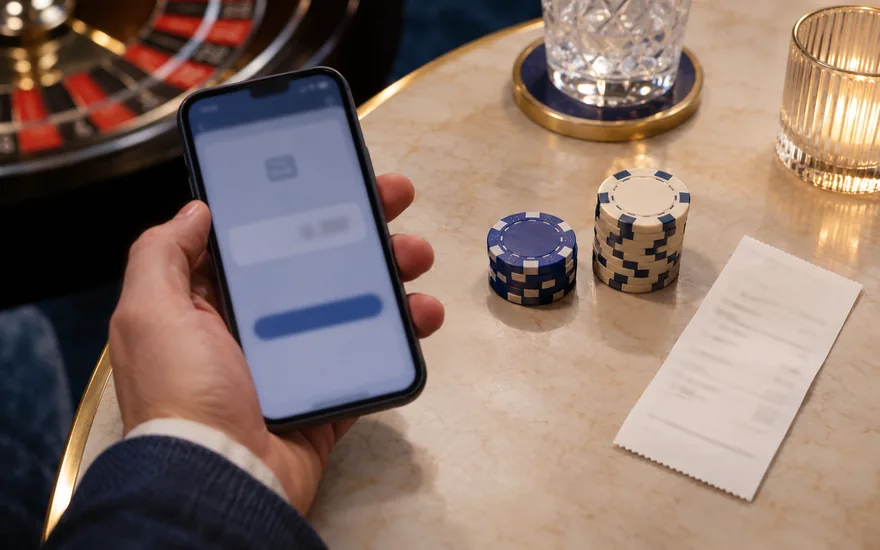
Lottoland's public deposit help describes opening the account wallet or using a quick-deposit option from the displayed balance. Those are documented entry points, not screens we accessed inside a customer account. Our review stops at reading the public instructions: no registration, deposit or withdrawal was performed to create this guide, and the photographs are not account screenshots.
In an existing eligible account, inspect the chosen method, currency, minimum and any fee before authorisation. A prefilled amount is a suggestion from the interface, so compare it with the published instructions and your intended amount. You can stop at that screen. Submitting money merely to see whether a smaller amount would work creates a transaction without answering the question beforehand.
Record the method name as displayed. A bank checkout may not be the same service as a manual transfer using beneficiary details and a reference. Similarly, an Apple Pay button is different from typing a card number into a card form. Those distinctions help you compare the published method row with the option that the cashier actually presents.
If the public help and account screen disagree, pause at that point and ask for clarification. Include the method name, GBP amount and the relevant page heading, with personal details removed. There is no need to send a PIN, one-time code or complete payment credential in a general support message. The disagreement is a documentation question, not a reason to keep retrying.
How can repeated one-pound payments change the comparison?
The size of one transaction is different from the total spent over a period. Five separate £1 payments add up to £5, whether they occur through the same route or different routes. A low minimum makes small transactions possible; it does not place a ceiling on their cumulative cost or automatically reserve money for other expenses.
When comparing a £1 route with a £10 route, write down the amount you actually intend to risk before looking at promotional messages. The larger funding floor is a condition of that route, not an argument that your budget should expand. Our £10 comparison separates exact £10 minimums from routes that accept smaller payments as well.
Track successful payments together rather than treating each fresh browser visit as a new budget. A failed-looking request should also be reconciled before a replacement is authorised, because the bank record and casino balance can update at different times. A transaction reference is more useful for that reconciliation than a memory that the screen appeared to freeze.
Existing limits and exclusions remain meaningful at small amounts. If an account or bank is preventing a payment, changing to a wallet, voucher or crypto-related route is not the next comparison step. Stop and understand the restriction. Independent gambling-support information is available without creating another gambling account or making another deposit.
Which costs can outweigh the entry amount?
Compare the amount deducted from the funding account with the amount credited in GBP. A payment service can have its own transfer or conversion charges even when an operator describes the deposit as free. This guide does not assign an invented fee to the £1 routes: the relevant account's fee information and the checkout's actual presentation must supply that figure.
A fixed charge has a different effect from a percentage charge. In a purely hypothetical example, a 20p cost on a £1 transfer equals one fifth of the transfer amount. That calculation is not a statement that any operator in this table charges 20p. It shows why a reader should compare the whole deduction rather than only the cashier floor.
Currency matters as much as the number. A dollar-denominated comparison is not a pound-denominated comparison with a different symbol pasted over it. If a funding account uses another currency, identify the conversion provider and the actual GBP amount reaching the casino. Do not assume that one unit of another currency will satisfy a £1 minimum.
Avoid buying a separate payment product solely to conduct a one-pound experiment. The account may introduce a balance, conversion step or withdrawal route that you did not previously need. The wallet comparison explains those separate stages, while our bank-statement guide helps distinguish the merchant entry from an earlier transfer into a payment service.
How does the £1 shortlist differ from a £10 shortlist?
An exact £1 shortlist asks which documented routes allow the smaller transaction. A £10 shortlist can mean either an exact £10 floor or simply acceptance of a ten-pound payment. Those meanings produce different tables. The same operator might qualify for the second question without qualifying for the first, so the amount alone is an incomplete category label.
For example, the official Grosvenor payment table lists £5 for its debit-card routes and £10 for Paysafecard. The distinction belongs to the method, not a single blanket number for the operator. We keep those cases in the ten-pound comparison as labelled alternatives instead of changing their published floors to make every row look identical.
The cashier minimum says nothing about game selection, withdrawal speed or customer service. None of those qualities can be calculated from the funding floor. Use the amount to decide whether the route fits the planned payment, and seek separate evidence for any other comparison. Otherwise a single documented number begins to stand in for an operator review that has never been carried out.
The practical decision is whether the documented route fits an amount you had already chosen and an outgoing arrangement you understand. If either side is unclear, the comparison has found a reason to ask a question or stop. It has not found a reason to increase the payment, open extra accounts or chase a balance that a promotion advertises.
What if the smallest available game stake exceeds the balance?
A documented £1 cashier minimum establishes that a payment route can accept that amount. It does not establish that every game accepts a stake of one pound or less. Before comparing a casino for a particular game, inspect that game's own total minimum. A live table, side bet or multi-unit selection may have a different entry condition from a slot or another table.
Suppose a hypothetical account contains £1 but the selected game requires a £2 total stake. The game and budget do not fit. The correct comparison result is that this particular choice cannot be funded by the intended balance. It is not a recommendation to add another pound, select a riskier bet or search for a promotional balance that appears to cover the gap.
The opposite arithmetic can also be misunderstood. A game accepting 10p does not establish that ten rounds will last a particular number of minutes, or that the balance will remain available through all ten. Game duration and settlement differ, and returns are variable. A deposit comparison should leave those unknowns visible rather than describe an inexpensive transaction as a guaranteed session.
Before funding, ask whether the named game and bet configuration allow the total stake you intend. That gives support a specific rule to check. Asking only about cheap games leaves the game, configuration and full commitment undefined. You can obtain the clarification without submitting a payment or trying a round, and the answer need not include advice on how to win.
How can a comparison record distinguish £1 paid from £1 displayed?
Use the deposit receipt to identify a completed payment, and the account balance to identify the current amount held. Those numbers can coincide immediately after funding, but they are not the same kind of record. Later play, an adjustment or a withdrawal request can change the balance without changing the historical amount of the original deposit.
A screenshot showing a £1 balance therefore does not substantiate a £1 minimum deposit. The balance could have arisen in several ways. Conversely, a receipt for a larger payment does not prove that smaller payments were impossible. For the comparison question, the documented floor and selected-method instructions provide the relevant evidence; the current balance answers a different question.
When two figures fail to match, identify which record each comes from: the deposit receipt, cash balance or promotional balance. That prevents a balance screenshot from being mistaken for proof of cashier acceptance. Send the relevant transaction reference through the operator's secure channel and describe the mismatch in those terms. Support can then address the particular entries rather than guess what a cropped balance represents.
A matching withdrawal floor is not a spending target
A published £1 outgoing minimum, where separately substantiated, answers a request-size question. It does not tell a reader to keep a balance at that amount through play. If an account has less cash available, the appropriate inquiry concerns how the existing residual money is handled, rather than which game might increase it to the threshold.
For a hypothetical 70p residual balance, the arithmetic gap to £1 is 30p. That calculation does not make another 30p payment or a wager an administrative requirement. The operator's actual process must explain the return of existing funds, and the inquiry can be made without trying to create a winning result.
This keeps the comparison centred on the documented route and chosen amount. A small floor can make a category easy to understand, but it cannot decide affordability, guarantee a usable game stake or turn a future outcome into money already available. A precise minimum is useful only while those separate meanings remain visible.
Questions about one-pound casino deposits
What casino can I deposit £1 in?
Lottoland's official UK help currently lists £1 for Visa debit, Mastercard debit, Apple Pay, Trustly and Pay by Bank. Confirm the actual method and GBP amount in your eligible account before authorising a payment.
Are all Lottoland payment methods £1?
No. The same published table lists Paysafecard at £2. The method row matters more than a general low-deposit headline.
Does a £1 minimum deposit mean a £1 minimum withdrawal?
Not automatically. We checked Lottoland's separate withdrawal help, which currently lists £1 for its named bank and card routes. Do not apply that figure to another operator.
Can I get a bonus by depositing one pound?
This comparison does not confirm a promotion at that amount. Read the specific qualifying deposit, payment restrictions and opt-in conditions separately.
How many spins does £1 buy?
There is no universal number. Divide the balance by the game's total permitted stake only as an arithmetic illustration; returns and game rules make actual play variable.
Is a one-dollar deposit the same as a one-pound deposit?
No. They are different currencies. A GBP cashier minimum requires the actual amount credited in pounds, including any applicable conversion.
Should I deposit more if my balance is below a withdrawal minimum?
No. Ask the operator about returning the residual cash balance rather than adding money or gambling towards a threshold.
Did Payment Table GB test a £1 transaction?
No. This is a review of public payment documentation. We did not open or fund gambling accounts, and we do not publish borrowed personal-test claims.
For a supported card-backed checkout, read the Apple Pay record checks separately from the published amount floor.
Sources and review
Reviewed 10 November 2026. Amounts are attributed to the specific published route; availability and account instructions can change. Official public documents were read without a gambling transaction.