 Payment




 Pragmatic Play
 Pragmatic Play
 Pragmatic Play
 BGaming
 BGaming
 Hacksaw Gaming
 Hacksaw Gaming
 Hacksaw Gaming
 Habanero
 3 Oaks Gaming
On this page
- What makes one game guide different from another?
- Which studio and title should you identify first?
- How do the feature families differ?
- What do the return and volatility fields establish?
- Where should a payment question go instead?
- Choose a reading route by the event you want to understand
- Follow the three Pragmatic Play sequences separately
- Compare the two BGaming originals without importing their relatives
- Read Hacksaw's changes in the order they happen
- Keep paths and held collections outside a borrowed line diagram
- Understand what the filters leave out
- Use a fact table with its surrounding explanation
- Distinguish a themed scene, a provider image and a rule preview
- Turn a confusing result into a precise reading query
- Sources and review
What makes one game guide different from another?
An expanding Wild, a layer reveal and a locked Bonus symbol can all change a board without using the same rule. These guides identify the event, explain what changes next and separate the symbol's job from a payment or feature trigger.
Each article has its own factual table, original themed scene and illustrated rule preview. Where a provider screenshot is available, it is labelled as that provider's image. A drawing that explains a sequence is not presented as a screenshot or a round we played.
The game cards link to one page per title. Different spellings, RTP questions and feature terms stay within that same guide. This keeps the original, a sequel and a seasonal edition from becoming interchangeable merely because they share part of a name.
Which studio and title should you identify first?
The catalogue includes Pragmatic Play, BGaming, Hacksaw Gaming, Habanero and 3 Oaks Gaming. Studio identity helps locate the primary rules, but does not establish the configuration or availability of any game at an individual casino.
For example, Fruit Million concerns BGaming's original release. Its Respin and seasonal search results should not supply missing facts. Scarab Temple is separate from both RA & The Scarab Temple and Hacksaw's Temple of Torment.
| Reading task | Useful starting guide |
|---|---|
| Follow a retained-symbol event | Cash Bonanza |
| Separate an outer-reel upgrade | Mystic Chief |
| Read layers beneath winning symbols | Rainbow Reels |
| Check substitution and a line multiplier | Aztec Magic Deluxe |
| Distinguish a reset from an addition | Scarab Temple |
How do the feature families differ?
Some games continue evaluating after symbols change. Others lock a collection while a separate counter runs down. Orbs of Atlantis follows adjacent paths and replacements; a conventional five-reel line sketch would not accurately explain that structure.
Dawn of Kings selects special expanding symbols through its Book features. Mighty Masks reveals mystery symbols and uses a nudge wheel. A shared multiplier headline does not make the order of those events identical.
Use the filters as reading shortcuts. A feature-family label identifies the distinction explained by the article; it is not a complete software classification or a prediction that one family will perform better in a session.
What do the return and volatility fields establish?
RTP numbers are quoted only where the provider source supports them without an unresolved conflict. Some studios publish several configurations. The highest figure on a review cannot establish the version actually running in a particular account.
A published volatility label is preserved as the studio describes it. The unclassified filter simply groups cards where this publication does not quote a verified provider classification. It does not mean those games have no variability or belong to the same risk category.
Neither field predicts the length or result of an individual session. Set an affordable money and time boundary independently. A larger prize ceiling or more elaborate animation does not supply a reason to extend that boundary.
Where should a payment question go instead?
The payment guide index identifies wallet accounts, card-backed checkouts and outgoing transfer records. Those instructions concern movement between accounts. They should not be confused with the internal symbol sequence or prize calculation explained by a game guide.
Read the current stake and game information before confirming an instruction. This library does not provide a casino ranking, operator availability list or funded-account test. Its editorial method explains how public sources and uncertain facts are handled.
Choose a reading route by the event you want to understand
Start with the event that confused you rather than reading alphabetically. If winners stay in place while other positions change, the retained-symbol explanation in Cash Bonanza is the useful starting point. If winners disappear to expose symbols underneath, try Rainbow Reels. Following what happens to the symbols gives you a more precise route through the library than calling every busy board a cascade and hoping the same explanation applies.
If a collection remains while a counter runs down and resets, start with Scarab Temple. Its held Scarabs and respin allowance give two things to track at once. If the main uncertainty concerns a symbol revealing into another symbol, Mighty Masks has the relevant mystery process. A reveal and a collected value are different mechanisms even when both involve a special-looking icon occupying a cell.
For a multiplier query, identify what is multiplied before choosing the article. Aztec Magic Deluxe connects its substituting Wild to a qualifying line payment. Mighty Masks describes a wheel multiplier applied to the current spin's total. Cash Bonanza describes a multiplier built during Free Spins. These scopes are not interchangeable. A number followed by an x is only the beginning of the explanation; the object it modifies completes the meaning.
One clear comparison may be all you need. There is no requirement to inspect every title or open a playable product after reading. If the guide answers your query, or identifies a detail the public source leaves unknown, the task can end there. Follow a related link when it helps clarify a particular contrast; the collection is a reference you can dip into whenever an unfamiliar rule needs explaining.
Follow the three Pragmatic Play sequences separately
Cash Bonanza, Mystic Chief and Rainbow Reels share a provider in this catalogue, but their central explanations differ. Cash Bonanza begins with a ways structure and follows retained winning symbols through its Increasing Ways Respin. Its free-spin multiplier has another job. Keeping those mechanisms separate prevents the expanding opportunity in one sequence from being described as if it were the multiplier used in the other.
Mystic Chief is most useful for readers who need to distinguish regular Wilds, expanding Wilds, a golden-coin Scatter and sticky Bonus symbols during Free Spins. Its Bonus symbols can cause a transformation, and an outer-reel condition during Free Spins can activate Super Free Spins. That is a state-specific upgrade, not a reason to count every Bonus appearance as the same event. The article deliberately leaves unsupported initial allocations unresolved.
Rainbow Reels provides the layer comparison. Winning symbols disappear to expose another layer, and the bonus description gives a special role to exposing the seventh layer. The resulting Wild can contribute to as many as thirteen wins before removal. The upper bound and the triggering depth need to stay attached to that description. They do not describe the number of initial spins or a guarantee that every feature reaches the same depth.
Reading these three together is an exercise in sequence vocabulary: retain, transform and expose. The provider name helps you locate the primary source, but it does not erase these differences. A screenshot from one title cannot supply a missing layout, free-spin count or return figure for another. The library's common presentation is there to make the articles navigable, while their factual explanations remain specific to each release.

Compare the two BGaming originals without importing their relatives
Aztec Magic Deluxe is documented here through its original product page and rules. Its fifteen-line structure, substituting Wild and ten-Free-Spin trigger provide a clear reading task. The line using the substituting Wild is trebled under the stated rule. A separate optional card-guessing feature is described by the provider, but this catalogue does not assume that every deployment exposes the same control or that using it is necessary to understand the base result.
Fruit Million has a different set of distinctions. Its original rules describe a hundred paylines, expanding Wilds on reels two to four and two Scatter types with different payment conditions. The presence of those Scatters does not justify adding a Free Spins feature that the opened original-game text does not establish. A common category name such as Scatter must remain connected to its actual job in the named release.
Searches can also surface Fruit Million Respin and seasonal editions. Those are not used to fill gaps in the original game's grid description or settings. A sequel can preserve artwork while changing a mechanism; a seasonal version can share a name while publishing different figures. The exact edition is therefore part of the factual identity, alongside the studio and title. A guide that merges editions can sound detailed while explaining no single version accurately.
These articles also show two different evidence situations. Fruit Million has a provider-published return figure retained with its scope. Aztec Magic Deluxe has unresolved conflicting primary page information, so the catalogue does not choose a convenient RTP or volatility label. Leaving the field unclassified is a deliberate limit on the claim. It is not a hidden judgement that the game is safer, riskier or mechanically identical to another unclassified card.
Read Hacksaw's changes in the order they happen
Temple of Torment separates Golden Scarab expansion from the Wild multipliers affected by that expansion. The two named features then alter Scarab and Wild behaviour in different ways. Its article follows the relevant object through the sequence rather than collapsing everything into “expanding Wilds”. That precision matters because the source describes adding multipliers involved in a win, a mathematical instruction that should not be transferred to another title without evidence.
Dawn of Kings centres on a Book that has both substitution and bonus-scatter functions, alongside selected expanding paying symbols. Different Book counts lead to different feature descriptions. Its Best of Bonus runs three complete bonus sequences but awards only the highest result. That is a selection rule. Adding all three displayed results would misstate the feature even if every animation had been watched carefully.
Mighty Masks begins with a mystery reveal, and qualifying Masks spread down before that reveal. A Nudge Wild then relates to a wheel applying a multiplier to the current spin total. Fifty is a maximum nudge count in the published description, not a multiplier range to assign to the wheel. The article distinguishes a movement count from the value eventually applied, which is the key to reading that headline accurately.
The three guides also differ in what the public source establishes numerically. Temple of Torment and Mighty Masks list return configurations in their provider data. Dawn of Kings does not supply a verified return option, volatility label or payline count in the current source used here. Do not use the presence of data on neighbouring cards to infer the missing values. The common provider is a source-finding aid, not a permission to copy statistics between releases.
Keep paths and held collections outside a borrowed line diagram
Orbs of Atlantis is included partly because it challenges a familiar reel assumption. Habanero describes adjacent symbols on paths without conventional reel strips, followed by removal and replacement of winners. A five-reel line sketch would not explain the stated structure. The article asks the reader to follow the actual path and its qualifying adjacency instead of drawing a convenient horizontal route through the artwork.
The return options for Orbs of Atlantis are quoted approximately, just as the provider gives them. Its Free Games description also keeps the words “up to”, and conflicting multiplier statements remain unresolved as a game-wide cap. Read those qualifications with the figures. Rounding a source into extra decimal places or turning an upper bound into a fixed award would make a neat table less accurate, even if the result looked more precise.
Scarab Temple supplies a different contrast. Its Hold & Win feature locks Scarab Bonus symbols while the respin counter can be restored to three. The collection changes when a new qualifying symbol arrives; the counter follows its reset rule. Persistence of a symbol is not itself a fresh award on each respin. Counting the same held value repeatedly would mistake a continuing board state for a series of independent credits.
Its Pyramid Free Spins route uses another symbol and another allocation. The article keeps that route separate from the six-Scarab Hold & Win trigger. It also identifies the 1,000-times Grand as a particular prize associated with the full board, rather than presenting it as proof of the whole game's maximum. A path cascade and a held collection may both look active, yet the objects, counters and settlement boundaries differ.
Understand what the filters leave out
A studio filter answers who publishes the named title. A feature filter groups a useful reading distinction. A volatility filter uses a published provider label where the evidence supports one. None of those filters can establish whether a game is available to a particular account, what stake options it has in pounds, or whether an operator deploys a particular return configuration. Those are different facts requiring different evidence.
Feature families are intentionally concise. A title can include several mechanisms while a card highlights the one most useful for this article. Cash Bonanza has both a retained-symbol explanation and a free-spin multiplier. Scarab Temple has both held-symbol respins and Pyramid Free Spins. A short family label is an entry point, not a promise that every other feature is absent. Open the article for the full supported explanation.
Unclassified is also a publication state, not a universal property of the software. It means this catalogue does not quote a resolved provider volatility classification for that record. It should not be treated as a middle category between low and high, nor as evidence that the game has no variation. Filtering can narrow a reading task, but it cannot turn missing evidence into a risk measure.
The native fragment links let you move to groups within the library. They do not modify a game, select a stake or change eligibility. A filter click is a navigation action. Keeping that action distinct from a game control is part of the editorial design: the library organises explanations, and its internal Play link leads here as a reading destination. It does not function as an operator or affiliate launch instruction.
Use a fact table with its surrounding explanation
A fact table is easy to scan, but its cells need the prose around them. A published RTP can describe a provider option while the active configuration remains unknown. A maximum can describe a ceiling without telling you its frequency. A release date can identify a product without proving current availability. The table supplies a compact reference; the explanation supplies the boundaries that keep the reference accurate.
An empty field leaves a fact unknown; it cannot be read as zero or filled from the next game in the library. Here that includes unsupported GBP stake ranges, operator availability and some initial Free Spins counts. Use the surrounding explanation to see which detail the primary source supplies and which it leaves open. Borrowing a value from a related release would produce a fuller table while making this title harder to identify accurately.
Return and volatility also answer different questions. A long-run model does not predict the result of one session, and a provider volatility word does not specify how long a particular balance will last. Two cards with similar labels can still have distinct mechanics and distributions. Read those fields as scoped product information, not a promise that a selected time or money boundary will be enough to reach a feature.
For a live product, use the running information panel to confirm the exact version and stake basis before interpreting any multiplier in cash. This catalogue does not perform that account-specific check for you. Its contribution is the vocabulary needed to identify what needs confirming: total stake, unit, configuration, feature state and settlement scope. A clear list of unknowns is more useful than an unsupported universal answer.
Distinguish a themed scene, a provider image and a rule preview
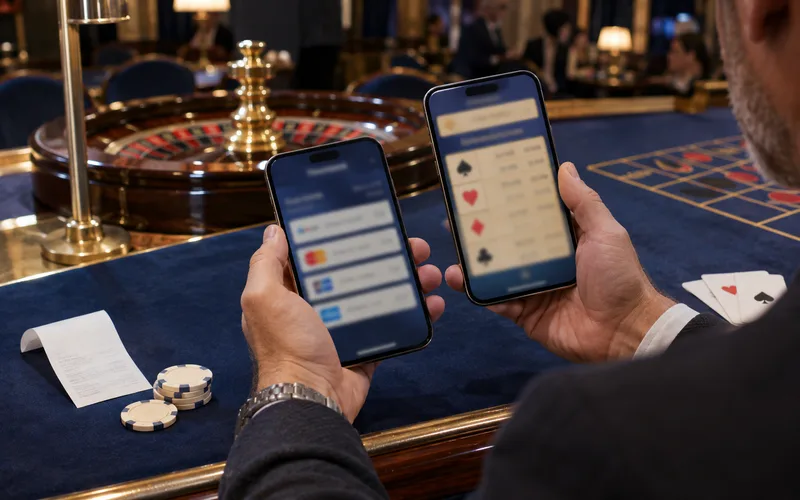
The original casino photographs provide visual context for the article. They do not document a real round, a tested device or an operator's game lobby. A phone in a themed scene is part of that illustration. Its presence does not establish launch performance, screen dimensions, available stakes or the exact appearance of a running version. Captions are included to keep that visual role separate from the factual mechanics.
Where a provider image appears, it is attributed as a provider-published screen or feature image. That offers a closer visual reference for the product, but still has limits. It can show what the provider chose to publish without proving the current configuration of another service. A promotional image may omit the help panel or the stage immediately before the pictured result. It should be read alongside the source text, not in place of it.
The illustrated rule preview has a third role. It assumes a stated condition and demonstrates the resulting change, such as a reset or reveal. It does not generate random game outcomes and is not described as a demo we played. No verified embedded runtime is supplied. This allows the article to explain an interaction honestly without presenting a mock interface as evidence of genuine gameplay or unrestricted consumer access.
If you want to learn a mechanic, that fallback can be sufficient. If you want exact active-version information, it cannot replace the actual rules. If you want to know whether a consumer demo can be accessed in Great Britain, read the separate demo-age guide. Each visual or source type should answer the task it can support, with its limits visible rather than silently carried over to another task.
Turn a confusing result into a precise reading query
Start with the smallest uncertainty. Was a symbol eligible to substitute? Did a retained icon represent a repeated value or one continuing value? Did the counter reset or receive an addition? Was a multiplier attached to a line, the spin or a complete feature? These questions can often be answered from the relevant article and primary rule without opening another game. A broad statement that the result “looked wrong” is harder to resolve.
For an actual completed round, keep the round identifier and the exact title alongside the relevant rule. A cropped picture can omit the active feature or stake. A provider fact table cannot reconstruct the account-specific event. If a support explanation is needed, describe the particular transition and the amount or counter you expected under the stated rule. That makes the query concrete without asserting that an unexplained animation proves an error.
Keep any disputed result tied to its existing round record. New bets produce new sequences, so trying to reproduce an animation will not explain the earlier settlement. A demo that reaches the same-looking feature cannot prove what a cash round should have paid either. Use the relevant rule and the completed-round details to frame the query; there is no need to keep playing while waiting for a more convenient example to appear.
The same discipline keeps payment issues separate. A game credit, a withdrawal request and receipt in an external wallet are different events. Use the payment pages for transfer references and the slot pages for symbol mechanics. When the correct record is identified, a confusing story can become a small, answerable query about one rule or one stage, with no need to extend the session.
Sources and review
Reviewed 11 November 2026. Each linked game guide lists its own primary provider sources. This publication index organises those guides; it does not add an unsupported game setting or operator claim. Sources include Pragmatic Play, BGaming, Hacksaw Gaming, Habanero and 3 Oaks Gaming.