 Payment


It does not tell you the payout for a natural blackjack, the number of decks or every player decision. Read those rules separately. This guide explains the total and the dealer's procedure without presenting a betting system or promising a profitable session.
On this page
- Count the ace twice before naming the hand
- H17 and S17 describe the dealer
- Walk through a dealer draw
- A player soft 17 is another decision
- Keep natural-blackjack settlement separate
- Use the rules screen before the payment screen
- Check the name against the total
- Build the total from a low starting value
- More than two cards can make the same soft total
- Follow a sequence without freezing the first label
- Distinguish a dealer instruction from a player option
- Interpret table wording as a complete sentence
- Keep the wager and settlement out of the hand name
- Compare two rule summaries without inventing a rating
- Prepare a precise inquiry about a completed hand
- Recheck the definition using contrasting hands
- Recount several aces from the lowest total
- Soft-17 questions
- Sources and review
Count the ace twice before naming the hand
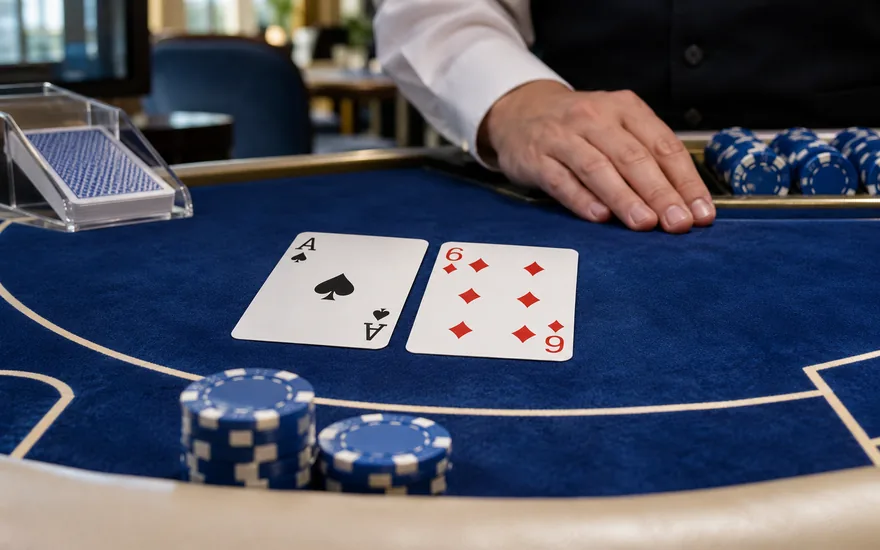
An ace can count as one or 11 within a valid blackjack total. With ace and six, counting the ace as 11 produces 17; counting it as one produces seven. The available lower total is why the hand is called soft.
A ten and seven also make 17, but there is no ace that can change from 11 to one. That is a hard 17. An ace in the hand does not automatically make every total soft: it must actually be usable as 11 without exceeding 21.
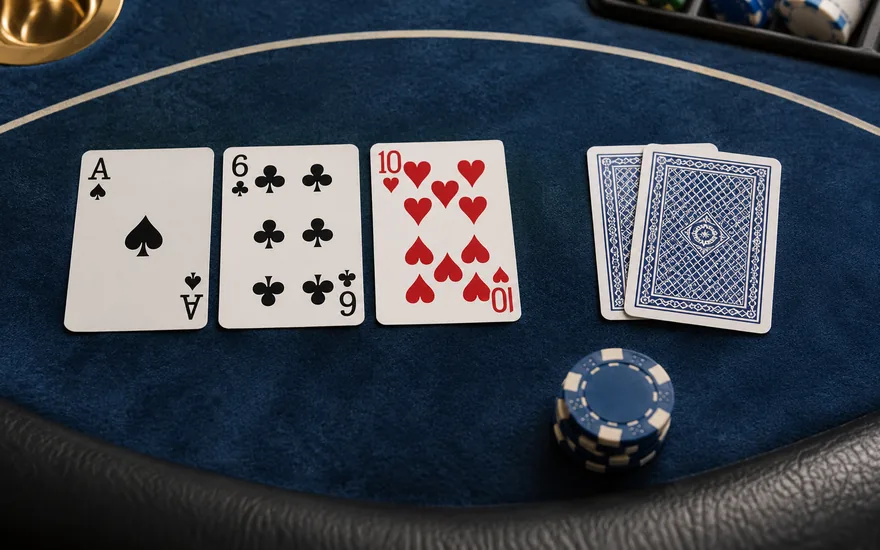
For example, ace, six and ten total 17 only when the ace counts as one. Counting it as 11 would produce 27. The resulting hand is hard 17, despite still containing an ace.
| Cards | Valid high total | Soft or hard? |
|---|---|---|
| Ace + six | 17 | Soft 17 |
| Ace + two + four | 17 | Soft 17 |
| Ten + seven | 17 | Hard 17 |
| Ace + six + ten | 17 | Hard 17 |
H17 and S17 describe the dealer
H17 means the dealer hits soft 17. S17 means the dealer stands on soft 17. The dealer follows the published procedure rather than choosing according to a hunch, the size of the customer's stake or the result of previous rounds.
Read the wording on the table or in the game help before a round begins. A short label such as “dealer stands on 17” needs the accompanying soft-total rule. If the help and the visible table wording disagree, do not assume the more favourable interpretation.
PokerStars' published blackjack rules illustrate how a game specifies its dealer procedure. That source describes the version covered by its own rules. It should not be applied automatically to another studio's live table or a similarly named blackjack variant.
Walk through a dealer draw
Suppose, as a hypothetical card example, a dealer has ace and six at an H17 table. The dealer must take another card. If that card is a ten, the ace becomes one and the resulting total is hard 17 rather than a bust.
If the next card is a two instead, the total can be 19 with the ace still counted as 11. The subsequent action follows the table's procedure. The example shows how the ace changes the total; it does not predict which card will arrive.
At an S17 table, the initial ace and six would stand. That is the exact decision point the two labels distinguish. There is no need to invent a payout amount to explain it, because drawing procedure and settlement are separate questions.
A player soft 17 is another decision
The dealer's H17 obligation is not an instruction that every player must hit every soft 17. Player decisions can depend on the dealer's upcard and the complete table rules, including whether particular doubles or surrender options exist.
A generic chart with no rule assumptions can therefore be misleading. If you consult one, establish the deck count and dealer rule it assumes. It cannot turn an individual hand into a guaranteed outcome, and it does not remove the risk of losing the stake.
You can understand the definition without adopting a staking sequence. Changing the wager after a loss leaves the next card unchanged. For a completed hand, the useful work is to count the cards and identify the applicable procedure. That remains possible after play has stopped; further stakes add no evidence about the hand already recorded.
Keep natural-blackjack settlement separate
A two-card ace and ten-value card is a natural blackjack under the standard definition, subject to the version's published rules. Ace and six is not a natural. The fact that both involve an ace does not connect their payouts.
Likewise, H17 versus S17 does not establish whether a natural pays 3:2, 6:5 or another stated amount. Those labels describe different rule dimensions. Write each rule separately when comparing two tables, instead of calling one simply “standard blackjack”.
For another settlement distinction, see baccarat Banker commission. It separates winning profit from returned stake. In roulette call bets, a single shortcut can place several chip units, creating yet another difference between a button label and the total exposed.
Use the rules screen before the payment screen
Establish which game and version are open, then read the rule that applies to the dealer's ace-containing total. A screenshot of another table or an old review is weaker evidence than the current game's own help.
If a round appears to have been settled inconsistently, preserve the round identifier and ask the operator to explain the rule used. Do not continue staking in an attempt to reproduce the problem. A new round cannot establish what happened in the old one.
The payment checklist concerns the separate question of funding and receiving money. Knowing the blackjack rule does not guarantee a payout route, and a convenient cashier does not make the game less risky.
Check the name against the total
For a rule enquiry, put the full dealer hand beside the instruction for that version. An image cropped to show only the ace leaves the total unknown. Retain all the cards and the table label so that the person reviewing the record can first check the count, then the action the dealer was required to take.
That also separates a counting mistake from a procedural one. If the ace must count as one to avoid exceeding 21, an H17 discussion may no longer apply. Work out the valid total first, then compare the dealer's action with the published procedure.
Build the total from a low starting value
One reliable way to classify a hypothetical blackjack hand is to count every ace as one first. Add the other cards using their blackjack values, then consider whether increasing one ace by ten would keep the total at or below 21. If it would, the hand has an ace usable as 11; if it would not, the usable total stays at the lower value.
For ace and six, the low starting total is seven. Adding ten produces 17, so the higher total is valid and the hand is soft 17. For ace, six and ten, the low starting total is 17. Adding ten would produce 27, so no ace can remain 11. The valid 17 is hard.
Recount the ace when another card arrives. Its value follows the whole hand, so a soft classification can change as the sequence develops. The total displayed at one point describes those cards at that moment. Carrying it forward as though the ace must keep its earlier value is what leads to a mistaken count of the next hand.
Use the full set of cards in the same hand. A dealer's upcard alone does not establish a dealer total, and a player's ace does not explain the dealer's hand. These examples are arithmetic exercises with stated cards; they are not observations of dealt rounds or instructions to place a wager.
More than two cards can make the same soft total
Soft 17 does not require exactly ace and six. In a hypothetical hand, ace, two and four produce a low total of seven and a valid high total of 17. Ace, three and three do the same. The total and the usable ace value matter; the count of cards alone does not decide whether the hand is soft.
Multiple aces need the same care. Ace, ace and five have a low total of seven. One ace can be increased by ten, producing soft 17. Counting both aces as 11 would produce 27 and is not a valid way to keep that total. The hand is soft because one ace can still function as 11, not because every ace does so.
Now add a ten to that last example. The low total becomes 17, and increasing any ace by ten would exceed 21. It is hard 17. The cards still include two aces, illustrating why the statement contains an ace is insufficient as a definition of soft.
If a hand is unfamiliar, write out its low total and the higher candidate total beside the same set of cards. They are two ways of counting one hand, rather than separate hands or bets. Then check which total is valid and apply the published procedure. Showing the arithmetic makes it easier to locate a counting error in a completed record.
Follow a sequence without freezing the first label
Take a hypothetical dealer sequence beginning ace and six under an H17 instruction. The initial hand is soft 17, so the stated dealer procedure requires a draw. If the next card is an ace, the low total becomes eight and the valid high total is 18. The hand is now soft 18, not soft 17 with an extra unused card.
If the next card is a four instead, the low total is eleven and the high total is 21. If it is a five, the low total is twelve and the high alternative would be 22, so the hand becomes hard twelve. Each result comes from recounting all cards rather than simply adding the new card to an unchangeable total of 17.
The hard-twelve example also shows why one draw is not necessarily the end of the dealer's procedure. The applicable rules must then be applied to the resulting total. H17 names the soft-17 decision point, while the complete dealer instructions specify the other totals. This article does not assume that the abbreviation alone contains every instruction needed for the remainder of the round.
At an S17 table the initial soft 17 stands, so that particular hypothetical continuation does not occur under the stated procedure. The contrast describes two rule sets applied to the same starting cards. It does not forecast which starting cards a dealer will receive or which version will produce a particular personal result.
Distinguish a dealer instruction from a player option
The dealer follows a prescribed drawing procedure. A player can face a choice among the actions permitted by the game. The H17 label identifies the former; it does not command the latter. Seeing a player stand on soft 17 therefore does not, by itself, show that an H17 dealer rule has been violated.
In a history containing several hands, first identify the dealer's cards and the action taken on them. A player's ace-containing hand may be visible nearby, with buttons offering the player a choice. Those buttons say nothing about the dealer's permitted actions. Follow the participant as well as the sequence before applying the dealer's soft-17 instruction to a recorded draw or stand.
Player decisions also depend on rules outside this guide's definition. Splitting, doubling, surrender and other permitted actions require the exact version's instructions. A generic strategy label cannot establish those permissions, and the presence of H17 in one part of the rules does not silently supply the rest.
Checking who acted and which rule applied does not require another wager. The same record can resolve a terminology question or help frame an enquiry about a completed round. Increasing the stake would add a new financial commitment while leaving the original count and dealer instruction untouched. Keep the investigation with the hand whose action you are trying to understand.
Interpret table wording as a complete sentence
A short label can omit the condition that matters. Wording about standing on 17 needs to be read with any separate statement about soft totals. A table might display an abbreviated instruction while the help supplies a fuller procedure. Read them together and identify any actual conflict before treating the shorter line as the whole rule.
For a hypothetical comparison, table A says that the dealer stands on all seventeens, while table B explicitly says the dealer hits soft 17. Ace and six are the point at which those instructions lead to different actions. Ten and seven do not illustrate that distinction because the latter hand is hard. Choosing the right example makes the wording easier to test logically without gambling.
The published PokerStars help example identifies a specific Classic Blackjack dealer procedure. That is evidence for the version its page describes, rather than a rule governing every table with a blackjack title. Retain the game name alongside the instruction when comparing it with another source.
If the visible game and help disagree, pause and request clarification through the operator's verified channel. Do not select the interpretation you prefer and continue on that assumption. The publication cannot override the current game's instructions, inspect its configuration or promise how an ambiguous record will be resolved.
Keep the wager and settlement out of the hand name
Soft 17 is a description of cards, not an amount of money. The same hypothetical ace and six can be associated with different stakes while keeping the same total. Changing a £1 stake to £2 does not turn the hand hard or change the arithmetic of the ace. Payment and wagering amounts belong to separate parts of the record.
Likewise, a total of 17 does not establish the final financial result. The round's settlement depends on the relevant hands and rules, including whether another condition has already settled the bet. This guide explains the dealer's soft-total instruction; it should not be read as a complete settlement engine for every possible blackjack situation.
A natural-blackjack payout illustrates a separate dimension. A stated 3:2 rule and a stated H17 rule can both appear in one game's instructions, but neither is implied by the other. One concerns a qualifying winning hand's payout, while the other concerns drawing on the dealer's soft 17. Compare them as separate entries rather than one bundled standard rule.
If a balance differs from your expectation, first identify the actual bet and settlement labels. A return may include a stake, while a profit figure excludes it. The baccarat commission guide provides a careful example of that distinction. The blackjack hand name alone cannot explain every movement in an account balance.
Compare two rule summaries without inventing a rating
To compare rule summaries, write down the exact game names and dealer soft-total instructions. Add other rules only where the source supplies them. If a payout or deck count is unknown, leave it marked unknown instead of borrowing from a similarly named game. The resulting note may be short, but each entry then points to a fact that can actually be checked.
For example, one document might explicitly state H17 while another merely says dealer stands on 17. The second needs clarification about soft totals before the two can be compared confidently. Calling it S17 by inference would hide the unresolved point. The guide's definition helps identify the missing wording, rather than authorising a guess.
H17 or S17 describes a dealer rule. It gives no evidence about responsive support, payment availability or withdrawal speed, each of which needs a source of its own. Record the rule difference for the question it answers. Turning it into an operator recommendation would extend a narrow instruction into judgements about services the rule does not describe.
Nor does the definition supply a personal expected return. Detailed mathematical comparisons require a complete set of assumptions and a clearly defined method. This page does not attach an unsupported percentage to the soft-17 label or promise a result for an individual session. Its task is to make the total and procedure readable.
Prepare a precise inquiry about a completed hand
For an apparent procedural discrepancy, retain the round identifier and full dealer hand. Identify the exact version, the instruction you read and the action you believe conflicts with it. An inquiry describing ace and six followed by a draw at a stated S17 table is more precise than saying the dealer behaved strangely.
Work out the total at the relevant moment. If ace, six and ten were already present, the valid 17 was hard. A complaint framed as soft 17 would then rest on a counting error. Keeping the sequence in order helps distinguish a hand-classification question from a real disagreement about the dealer's published procedure.
Use the existing record through the operator's verified support route. Do not provide a password or one-time code in a general message, and remove unrelated personal details from any image. This publication cannot retrieve private round history or adjudicate a disputed action. The contact guidance explains how to direct a provider inquiry separately from an editorial correction.
A new hand is unnecessary. It cannot establish what cards were dealt previously or which instruction applied then. If the game is causing pressure to continue or recover a loss, stop and use support resources. The historical reference remains useful without adding another round to the record.
Recheck the definition using contrasting hands
You can review the concept with three hypothetical hands without opening a game. Ace and six is soft 17 because the ace can be 11. Ten and seven is hard 17 because there is no adjustable ace. Ace, six and ten is hard 17 because the ace must be one to keep the total valid.
The contrast explains why an ace icon or the number 17 alone is insufficient evidence. You need the complete cards and their valid counted values. It also explains why more cards do not automatically make a hand hard: ace, two and four still have a usable eleven-valued ace and the same high total as ace and six.
Once the hand is classified, apply the correct instruction to the correct participant. H17 means a dealer draw on soft 17; S17 means a dealer stand on that soft total. Neither abbreviation chooses a player's action, establishes a natural payout or states a payment minimum. Keeping those boundaries separate is the core reading skill.
For other compact labels with different consequences, the table-game index connects this guide with baccarat commission and roulette group allocations. The related payment collection covers the independent records involved in moving money. Understanding either subject never requires another bet or a transaction test.
Recount several aces from the lowest total
Ace, ace, ace and four provide a further hypothetical counting check. Counting all three aces as one produces seven. Increasing one ace by ten produces 17, so the hand is soft 17. Increasing another would exceed 21; the definition never requires every ace to count as 11 simultaneously.
If a ten is then added, the low total becomes 17 and no ace can be increased. It becomes hard 17. The number of aces has stayed the same while the usable value has changed. This is a useful contrast with the mistaken idea that an ace-containing hand is always soft.
These stated cards let you practise the count without treating them as a round every table would deal. For a real enquiry, retain the actual order and the applicable dealer instruction. A correct total answers the counting question; the procedure then determines whether another draw was required. Both checks are needed before attributing an apparent discrepancy to the dealer.
Soft-17 questions
Is ace and six a soft 17?
Yes, when the ace can count as 11.
Is ace, six and ten still soft 17?
No. Its valid total of 17 uses the ace as one, making it hard.
Does H17 tell me what a natural blackjack pays?
No. Check the natural-blackjack payout rule separately.
Sources and review
Reviewed 10 November 2026. PokerStars blackjack rules supplies a published operator rules example. Card sequences here are explanatory hypotheticals, not reports of rounds played. For help taking a break, see support resources.